In a book titled, The Bottom Billion, a discussion about the poorest nations and their state in our world is had. Author Paul Collier identifies four traps that have prevented the nations of these last billion of people from developing or from developing effectively. The four traps are: landlocked, natural resources, conflict, and bad governance. But to this in perspective, I will discuss these traps through the nation of Venezuela to see how these traps apply, or don't apply, to its development.
We will begin with the trap of being landlocked. Defined as being surrounded by nations on all sides, the spillover from these neighbors is significant, especially if they are bad neighbors.
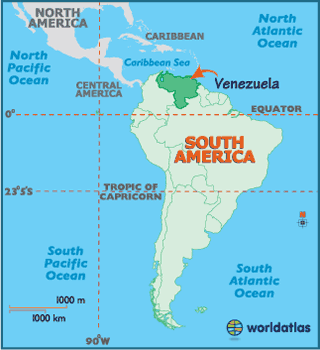
In Venezuela's case, it is not landlocked. It is on the northern tip of South America, surrounded by Colombia, Brazil, and Guyana to the east, south, and west but its entire northern side is a coast to the Caribbean Sea. This has allowed Venezuela to import and export very effectively. The landlocked trap is not very applicable to Venezuela because it simply is not landlocked. Though some can claim that it has a bad neighbor in Colombia, by not being surrounded by Colombia nor other bad nations, it is not debilitated in its development.
The second trap is the conflict trap. The conflict trap is focused on civil wars that many of these bottom billion nations are engaged in and these wars hold stark economic consequences with a large chance of relapse after such conflict. Venezuela experienced some political turmoil with its attempted coups in the early 1990's as well as the final election of Chavez and his launching of the Bolivarian Revolution, a social movement. However, none of these culminated in war, allowing Venezuela to be spared of the woes associated with countries still in and/or recovering from a civil war.
We now arrive at the trap of bad governance. Venezuela's resource of oil was discovered in the early 20th century around World War I, providing a general trend of great economic growth into the 1980's. The trap of bad governance is that poor leadership results in stagnation economically, often attributed with decline and other similar economic situations. But while Venezuela's had many different political systems, men, ideas, and powers going through office, its oil industry allowed it to become stronger economically over the 20th century, landing Venezuela where it is today.
The last trap is the natural resource trap. What this trap entails is that a nation will have or will come upon the discovery of natural resources that are valuable but a country's inability to control and manage this resource can lead to serious economic difficulties and have severe consequences. Venezuela plays close here because, as I afore mentioned, the oil reserves were found around WWI. Oil then dominated its economy, pushing its previous agricultural exports aside. However, this did not create significant issues as nations under the trap have experienced and instead Venezuela saw growth under their new found power of oil.
Overall, we have seen that Venezuela is not largely applicable to any of the four traps. This very reason should be Venezuela's motivation for the continuation of success. It is has been lucky to be hurt by the various coup's and the oil discovery. Yet Venezuela's government is not viewed positively around the world with heavy opposition from the US. Political issues can be brewing, but Venezuela should seek not to become hampered down with any such issue so as to remain as one of the leading nations in South America.
http://en.wikipedia.org/wiki/Venezuela#20th_century
We will begin with the trap of being landlocked. Defined as being surrounded by nations on all sides, the spillover from these neighbors is significant, especially if they are bad neighbors.
In Venezuela's case, it is not landlocked. It is on the northern tip of South America, surrounded by Colombia, Brazil, and Guyana to the east, south, and west but its entire northern side is a coast to the Caribbean Sea. This has allowed Venezuela to import and export very effectively. The landlocked trap is not very applicable to Venezuela because it simply is not landlocked. Though some can claim that it has a bad neighbor in Colombia, by not being surrounded by Colombia nor other bad nations, it is not debilitated in its development.
The second trap is the conflict trap. The conflict trap is focused on civil wars that many of these bottom billion nations are engaged in and these wars hold stark economic consequences with a large chance of relapse after such conflict. Venezuela experienced some political turmoil with its attempted coups in the early 1990's as well as the final election of Chavez and his launching of the Bolivarian Revolution, a social movement. However, none of these culminated in war, allowing Venezuela to be spared of the woes associated with countries still in and/or recovering from a civil war.
We now arrive at the trap of bad governance. Venezuela's resource of oil was discovered in the early 20th century around World War I, providing a general trend of great economic growth into the 1980's. The trap of bad governance is that poor leadership results in stagnation economically, often attributed with decline and other similar economic situations. But while Venezuela's had many different political systems, men, ideas, and powers going through office, its oil industry allowed it to become stronger economically over the 20th century, landing Venezuela where it is today.
The last trap is the natural resource trap. What this trap entails is that a nation will have or will come upon the discovery of natural resources that are valuable but a country's inability to control and manage this resource can lead to serious economic difficulties and have severe consequences. Venezuela plays close here because, as I afore mentioned, the oil reserves were found around WWI. Oil then dominated its economy, pushing its previous agricultural exports aside. However, this did not create significant issues as nations under the trap have experienced and instead Venezuela saw growth under their new found power of oil.
Overall, we have seen that Venezuela is not largely applicable to any of the four traps. This very reason should be Venezuela's motivation for the continuation of success. It is has been lucky to be hurt by the various coup's and the oil discovery. Yet Venezuela's government is not viewed positively around the world with heavy opposition from the US. Political issues can be brewing, but Venezuela should seek not to become hampered down with any such issue so as to remain as one of the leading nations in South America.
http://en.wikipedia.org/wiki/Venezuela#20th_century

No comments:
Post a Comment