Thursday, December 13, 2012

The Othered Muslims

Renowned psychiatrist Carl Jung, credited with founding analytical psychology, developed the idea of "the other". A critical line from this definition is "Others may be not-us, and so we can see how we are different from others. Otherness thus creates alienation and fear." Indeed, the other is often the embodiment of what we reject, what we seek to repress. Often we may other certain qualities of ourselves, creating a shadow reminding of us what and who we really are. But societies can other(verb) people different from the mainstream or modern society. In America we might reject this, considering ourselves the melting pot and lauding ourselves on our diversity. Yet subconsciously racism and prejudices persist, resulting in the othering of people. This has taken its most recent turn regarding Muslims in America. 

Muslims are othered. After our twin towers fell, the word "terrorist" took on a different meaning, one associated with Muslims. A harsh stigma against Arabs and more specifically Muslims was created not intentionally but just as notion of society. Many of us have had no need to face this stigma and thus it is easy to forget that it exists. But these men and women are still othered, even today. Islamophobia is a term now in use. This othering includes actions too, not just opinions. There are many stories of men and women unjustly searched or detained at airports under false presumptions. This article from BBC details hearings that are given to Muslims under the threat of terrorism, though most people are just average Americans who are practicing Islam and have no such affiliation. Yet in the land of the free, there are still many people who are being othered.


 Why do we other? I don't think we can avoid it as per the society we live in. For one, we are a very nationalistic nation and when our leaders declared enemies, us citizens followed suit. This is similar to the situations Japanese men and women living in America were facing during WWII, though not as extreme. But in both situations, we were attacked by one group of people, only to stigmatize and "other" all those even related. Our society also has standards of right and normalcy, and expressions too different from these standards also face the cold shoulder immediately. It is by our nature to support some and oppose those against. But we cannot continue to preach tolerance and not act upon it. As a society we have to learn that it is wrong to give unjustified prejudices to people of which only a very select few deserve. A tall order some may say, but we are the melting pot. And if we are to stay true to our name, then we must make the moves to do so. 


Wednesday, December 5, 2012

Venezuela Not Trapped

 In a book titled, The Bottom Billion, a discussion about the poorest nations and their state in our world is had. Author Paul Collier identifies four traps that have prevented the nations of these last billion of people from developing or from developing effectively. The four traps are: landlocked, natural resources, conflict, and bad governance. But to this in perspective, I will discuss these traps through the nation of Venezuela to see how these traps apply, or don't apply, to its development.

We will begin with the trap of being landlocked. Defined as being surrounded by nations on all sides, the spillover from these neighbors is significant, especially if they are bad neighbors.


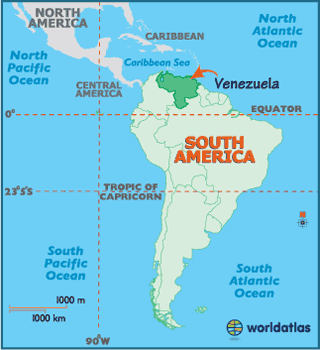
In Venezuela's case, it is not  landlocked. It is on the northern tip of South America, surrounded by Colombia, Brazil, and Guyana to the east, south, and west but its entire northern side is a coast to the Caribbean Sea. This has allowed Venezuela to import and export very effectively. The landlocked trap is not very applicable to Venezuela because it simply is not landlocked. Though some can claim that it has a bad neighbor in Colombia, by not being surrounded by Colombia nor other bad nations, it is not debilitated in its development.

The second trap is the conflict trap. The conflict trap is focused on civil wars that many of these bottom billion nations are engaged in and these wars hold stark economic consequences with a large chance of relapse after such conflict. Venezuela experienced some political turmoil with its attempted coups in the early 1990's as well as the final election of Chavez and his launching of the Bolivarian Revolution, a social movement. However, none of these culminated in war, allowing Venezuela to be spared of the woes associated with countries still in and/or recovering from a civil war.

We now arrive at the trap of bad governance. Venezuela's resource of oil was discovered in the early 20th century around World War I, providing a general trend of great economic growth into the 1980's. The trap of bad governance is that poor leadership results in stagnation economically, often attributed with decline and other similar economic situations. But while Venezuela's had many different political systems, men, ideas, and powers going through office, its oil industry allowed it to become stronger economically over the 20th century, landing Venezuela where it is today.

The last trap is the natural resource trap. What this trap entails is that a nation will have or will come upon the discovery of natural resources that are valuable but a country's inability to control and manage this resource can lead to serious economic difficulties and have severe consequences. Venezuela plays close here because, as I afore mentioned, the oil reserves were found around WWI. Oil then dominated its economy, pushing its previous agricultural exports aside. However, this did not create significant issues as nations under the trap have experienced and instead Venezuela saw growth under their new found power of oil.

Overall, we have seen that Venezuela is not largely applicable to any of the four traps. This very reason should be Venezuela's motivation for the continuation of success. It is has been lucky to be hurt by the various coup's and the oil discovery. Yet Venezuela's government is not viewed positively around the world with heavy opposition from the US. Political issues can be brewing, but Venezuela should seek not to become hampered down with any such issue so as to remain as one of the leading nations in South America.


http://en.wikipedia.org/wiki/Venezuela#20th_century

Thursday, November 15, 2012

Students Strive while the System Smiles

My math teacher sparked an interesting discussion the other day, one that I had thought about before but now took into real consideration. I now apply it here. Go back to your days as a student and pick one of the classes you took. Consider this question: If the grade in a class did not matter, would you still go for the best grade or for the learning experience? "Grades" was the much more common answer than "experience" and it has a good reason to be. For we need good grades to get a good academic standing, and then get into a good college, and to have a good future.

But why even ask that question? Because that is what our education system has made us believe in, to get the right grades and the right scores so that you can reach the right places. This is what the system runs on and what students have in turn come to believe. Have you ever heard a student say, "I would do anything just to better understand those concepts"? No. We instead hear students praying for A's, grubbing for some more points, or pouncing upon extra credit, just to get that most beloved first letter of the alphabet.

A fellow student in my class then asked a question, in a slight mocking manner saying, "Could you imagine us saying to a college, 'Yea I didn't get the best grade, but I learned a understood a lot!'?" He posed a good question. Much of the college admission process is a factor of a student's GPA, a measurement of the grades they have received in classes, and the scores on a variety of standardized tests such as the ACT, SAT, AP Tests, and the list goes on. Thus we must get little sleep and argue for points for those very grades could determine our future! Colleges do understand that grades alone don't determine an applicant (thankfully) and most also require teacher and counselor recommendations and short-answer or essay questions. 

Like I said, I have often thought about this. At certain points in my academic career, I was in a specific class or at least discussion where the concepts and ideas that we were being talked were so intriguing that I was genuinely interested and just wanted to keep talking about it. Then suddenly, it was an assessment of some sort, and I could not complete all the problems or couldn't detail my essay correctly, not reaching the grade I wanted. But I still understood what went on. It continues to frustrate me that such an emphasis on grades is had. To some extent, however, it is needed. Should students be assessed on solely their participation? Or how much effort they gave on the test rather than how many they actually got correct? It is a difficult system to work with, but perhaps the boundaries could be widened and explored.

The critique of the education system does not end there. Just as the system impresses upon students the significance of grades, the system itself impresses its own process upon students. That a certain curriculum is developed and should be taught in this manner. The teacher writes on the board, the students are to write the notes down word-for-word what is written. The only questions are what does that word say and what are the answers, the bell rings, and this all repeats. But are students really understanding what they are writing? Most are not, they are simply just mechanically copying. I am reminded of this picture that I had seen:


Indeed, where is our opportunity for exploration and discussion of topics and ideas? Our bubbles of thought are indeed shaped to fit the square, pointed, and regulated system of the teacher-a part of a bigger system. The focus on grades is just one part of this shaping that is done by the education system.

However, I will never discourage the importance of education. The fact that we are able to have such an education that allows us to become intellectuals, some more than others, is quite astonishing and a gift others around the world may not have access to. A lot of this expression of our selves and our minds may have to come after going through the education system, but the expression itself may not have been possible without education.

So what is the final say? That education system can be viewed as faulty, but is there any system that isn't? Students are taught to think and act in a certain manner, most significantly in the best interest of good grades. That does not necessarily inhibit the chance to have a good learning experience with a class, but may make it harder. The success in the system may overshadow its drawbacks. However, being aware of this fact can allow us to seek that experience that exists, and to explore ideas more than what is given. We can bend the box that our mind has been shaped too, but still keep enough shape to complete the system.


Sunday, October 28, 2012

Why WE Vote


In my post titled, “How THEY Vote”, I had described different factors that motivated, or demotivated people to vote. Compulsory voting, the ability of the individual to change the outcome, history, and the amount of faith in the government.  But now I take those factors now, and apply them to the American people. 

In America, voting is not compulsory. It is completely optional. This is a main reason as to why politicians spend so much money on campaigning. For this election, President Obama raised $934.0 m, while Romney raised $881.8m (NYTimes); outrageous amounts wouldn’t you agree? Because it is not enough for Romney or Obama to just get voters to vote for them, they need to get as many people to vote in the first place. Thus they raise and spend such excessive amounts of money to garner as many votes as they can to have more than the other. Yet as much effort as these candidates put forward, our turnouts continue to be low. In 2004 55.27% of the voting age population voted, and in 2008 it was 57.48%. Though we have seen increase in the last 12 years, we can hope to see if it continues to rise for this election. 


The ability of the individual to influence the outcome of the election is also a problem. There are multiple facets to this factor. First, because America uses the Electoral College, this creates some issues for people feel misrepresented. When a state ends of voting for the democratic candidate, then the entire population of that state that had voted for the republican candidate feels misrepresented for their vote has basically been thrown out. Secondly, the tradition of states to be “red” or “blue” states affects this. Texas, Alabama, Oklahoma, and Utah are among some of the states that traditionally vote Republican, red states. Thus it would be highly discouraging to be a democrat in such as state, knowing that their state would most likely vote the other way. What incentive do they have to vote then? The same goes for republicans in blue states. Thirdly, actual amount of people that do vote is indeed a lot. Thus if you are in a state that does match your beliefs, such as a democrat in a blue state, then why must you get up and vote knowing that there will be enough people to vote your way and win the majority? As far-out as these ideas may be, there are people who do follow this very mentality.


The factor of history does play a role as well. America was founded upon the principles of freedom and liberty, as was such the right to vote. The American people have always been able to vote; it is a right people take as sure as salt. The fact is, people have taken this right for granted and have lost the value of their ability to directly voice their opinion on who leads their nation. I had contrasted this with India, who had been under the colonial ruling of Britain until 1947. Thus the literate states such as Kerala have a high voter turnout, almost greater than 70%. The right to vote has never been challenged and thus people have lost their value so. 


The last factor to be addressed is the amount of faith in the government. This is a factor candidates have discussed in their campaigns that the government will be, or in Obama’s case, has been responsive to the American people. This can be argued back and forth but the fact of the matter is that people need and will vote for the leader under whom the government will be most responsive to their demands. This is huge factor in America because, as we iterate so often, the government is by the people and for the people. This has been the critic of Romney is some areas where he vows that it will help the people, like his policy proposals. People hold onto this ideal that the government is for them, and need to be given a reason to vote. 


With the election only 8 days away, we earnestly wait and see how the voter turnout is this year. But here’s a little bit of prediction. With an increasing trend in voter turnout, I feel that the turnout in this election will either be relatively the same or higher. Red states and blue states seem to be sticking with their colors, the only concern being swing states of Ohio. Several usual red states had voted democratic in the 2008 election, but they may return back to voting red. This is a tight race and it will be great excitement to see who comes out on top.  

Thursday, October 25, 2012

The Mass and Micro Media

            In 2001, Jonah Peretti and Nike had an email exchange over the customization of a shoe with the word “sweatshop” and it became hit on the micro media that quickly saw its way into the mass media, described in this article by Peretti http://www.thenation.com/article/my-nike-media-adventure. This article, shed some light on the distinction between micro and mass media. Personally, I had not realized the extent nor just how big this distinction was. I will begin by highlighting the characteristics of the three stages of micro media, the transition, and mass media. Peretti describes how he had emailed his correspondence with Nike to some friends and it had circulated from there reaching hundreds upon hundreds of people such as the college students and activists he describes. He notes the posting of his correspondence upon websites such as Plastic.com the transition between micro and mass media before it become discussed on publications such as the Time and Wall Street Journal. He also attributes reaching the mass media level with the increased number of emails he receives, the international stemming of his emails, and the extremity of his emails.
            What I notice is that the separation between the micro and mass media is very small. I go from email and Facebook to articles, discussions, and videos of mass media seamlessly. This is why I had trouble highlighting this distinction between the two. But there is a large difference between the two. Micro media contains everything, while Mass media only contains that either have vested interest, or that will sell and lead. This distinction can be highlighted by the Kony 2012 movement inspired by the group Invisible Children. They made this video and it became a sensational hit on the micro medial level, racking up millions of views, millions of likes, millions of shares, millions of emails, and so on. People were talking about it, it was praised, it was criticized, it was big. And the video made it to the mass media because of the hit it was in the micro media. It was noted for being the biggest viral video but also faced for stark criticism for being fictitious. Jason Russel, leader of Invisible Children, was featured on many TV and radio shows, describing the purpose of the video and justifying his cause.
            I have come to understand that from both the Peretti article and Kony 2012 is that the mass media, though a huge body capable of sustaining itself, depends on the micro media as its feed to the people to which it caters to. If people are talking about something, it will be in the micro media. If hundreds of people are talking about it, it will be all over the micro media. If “everyone” is talking about it, then the mass media will be on it too. The mass media, as much as it is a source of news and information, does seek to cater to the people by making huge what is the popular trend of the moment. A current example is the song “Gangam Style” by South Korean artist Psy. What is particularly sentimental or great about this song? Nothing, other than its catchy tune and funny dance moves. Yet it raged all over the micro media that soon enough Psy was dancing on talk shows and the Chicago Tribune had an article about his song; he had reached the mass media.
The micro media is what we listen to, what we are watching, and what we are learning.     And the mass media is what it sounds like: the larger of mass of songs and news catered to the world. But as described, the mass media is a factor of the micro media. The news the mass media broadcasts or the information it shares is an attempt to not simply inform the public, but to garner the attention of the public and get them involved through the micro media. The mass and micro media’s are woven together in a fine relationship, and we should seek to not just watch this go by, but to use this interaction between media to our advantage of an ever-connected world. 

Wednesday, October 17, 2012

Why THEY Vote


One of the primary focuses of an American today is the upcoming Presidential election. From constant political ads, to the debate that took part last night, President Obama and Mitt Romney are trying very hard to get people to vote for them. Because as much as people do vote in this nation, there is a large percentage that does not; the voter turnout for the 2008 election was roughly 57.4% (http://www.idea.int). Yet, smaller nations like Malta or Uruguay have much higher voter turnout. What is it about these nations, whose politics are not nearly as significant as that of the U.S, have such larger turnouts?

In some nations, voting is compulsory. But the turnout is a factor of the laws or sanctions that country has put against not voting. For example, Australia has mandatory registration for voting and attendance. Thus it reaches a turnout of 95%. Other nations have few or weakly enforced sanctions against not voting. Thus, citizens can get away with not voting. People require motivation to vote. But if they lack that motivation, and face no consequences by not voting, they will certainly choose not to vote. Venezuela witnessed this when it removed its mandatory voting laws and saw a decrease in its turnout.

A factor I believe that raises voter turnout in other nations is the ability of the individual to change the outcome. Knowing that your vote will be represented will spur many people to vote. This comes to head in countries with a plurality system where one party will misrepresent all the people that had voted against it. Thus, when people feel that they are not being represented, they will have little motivation to come to the polls. Look at Germany, where it is very easy to create a party and garner votes for it, requiring a 5% electoral threshold in order to be part of the parliament.

A little bit of history plays into this as well. While in hundreds of countries people can vote, there are some nations that had to establish their ability to vote. The U.S, since its beginning, has always given its people the right to vote. A country like India, however, was ruled colonially and did not achieve its independence until 1947. Thus its citizens value their ability to vote.

But I feel a significant, if not the most significant factor, is one that more felt than can be seen. Voters must have trust in their government in order to vote for them. Similar to what I was speaking to early, citizens must be able to trust in the electoral process and should face a responsive government, ensuring that people do feel their worth as citizens voting in their nation. When facing an election, candidates cannot simply address and vow to fix the issues the nation’s people have voiced. They have to give their citizens a reason to vote, and thus must derive their solutions from the people.

These various factors affect voter turnout, positively and negatively, around the world in different ways. As the election draws ever closer, I will apply these factors to America in my next post to see how We vote.


                            http://www.idea.int
                            http://en.wikipedia.org/wiki/Voter_turnout

Thursday, October 4, 2012

My City, My Cause


Living in Chicago has its benefits. The delicious pizza, the great landmarks, and my personal favorite, great sports teams. As a huge basketball fan, I love the Chicago Bulls and was distraught with the injury of Derrick Rose during the playoff run. He has been releasing videos every few weeks detailing his recovery, each one describing a different aspect of his road to playing again. But what struck me the most was his closing comments of the first of these video in which he says:

Nobody believed in me in the beginning. Just me and my friends. I mean, my frinds, my city, my fans, that's it, that's all I need. I wanna be great, I'm gonna be great. There's no doubt about it.

Rose speaks with such motivation! I clearly understood now, that what he does from this point is part of his attempt to become great. That the work he puts in, the time he gives, and the steps he takes are a factor of us fans and his past to reach his goal of a championship.

It’s this idea of motivation that I took to the rest of sports, discovering so much more meaning. New light was shed on hot topics such as the Ray Allen trade, the NFL referee’s lockout and quick resolution of dispute, and other such examples. But it begged the question, what else could this be applied to?

My questions were answered during the recent uprisings in the Middle East. The Syrian and Tunisian revolts and attacks was hit news around the world, especially after the American Embassy was attacked.  Why did these nations suddenly react and attack? Why were they trying to accomplish? What would be America’s response? Asking these questions I found that the “Arab Spring” of 2011 as it has been coined set a precedent for these nations to act so. In terms of the American response, I found that a quandary lie for President Obama. For his upcoming election forced him to reconsider every move he made to make sure that it wouldn’t be blasted by Romney and/or the American people. But he also needed to make assertive moves to help the situation. Such discussions of motivation is what this blog seeks to do.  

Ranging from sports, national events, or international crises, I seek to not only understand what’s happening and but why they are happening.  We often ask the basic questions of Who, What, Where, When, and Why. So I seek to go into the What and explore the Why and help all of us understand better. Perhaps together we can figure out the motivation behind events as well.

But who am I to propose this? I’m Shawn Kurian, a senior in high school and an aspiring intellectual. I've been questioned more recently about my motives for my decisions regarding college. A question I had before easily brushed off, I realized my motivation was much more complex than “wanting a good future.” Rather it was combinations of  the different factors of family, school, skills, and dreams. So I take this lens of motivation, my interests in sports and the world, and this blog to discuss and get a better understanding of the What and the Why.